In India, Honda’s big bikes are mainly known for their bulletproof reliability, low running costs, great resale value and (in most cases) high initial purchase price. Enter the CB1000 Hornet SP, a bona fide 1,000cc four-cylinder supernaked with Brembo brakes, Öhlins suspension and a comprehensive suite of electronics. Its Rs 13.29 lakh (ex-showroom) price gives bikes not just one but sometimes even two segments below a run for their money! Surely there has to be a catch here, right?
Honda CB1000 Hornet SP usability and performance – 9/10
Despite its fierce performance, the Hornet is a surprisingly friendly and forgiving machine
It’s nearly midnight when I was handed the keys to this fierce-looking machine – by a trusted friend, no less! – so to say a lot was riding on how I handled the next few moments would be an understatement. Engine awake and warm, I plonked it into first and eased the clutch out ever so gently.
| Engine and output | |
|---|---|
| Engine | 1000cc, four-cyl, liquid-cooled |
| Power | 157hp at 11,000rpm |
| Torque | 107Nm at 9,000rpm |
| Gearbox | 6-speed |
The 22km ride home that followed took me by surprise because this 157hp bike felt utterly easy to ride, even for a rather inexperienced rider like me. Since I had no intention of contacting my orthopaedic surgeon again, I kept it below 5,000rpm and stuck to the sensible yet undoubtedly quick Standard riding mode that night.
The Hornet is a 1000cc big bike that can realistically be used on our roads.
Next morning, when I encountered some wide open roads, I mustered up the courage to put it in Sport and be a little more prodigious with the throttle. Instantly, something angry inside the Hornet awakened, and I was being catapulted toward the horizon with alarming ferocity. What added to the excitement was the Hornet’s surprisingly loud exhaust note from that big ‘dustbin’ muffler. Below 6,000rpm, with the butterfly valve shut, it was an angry growl, but once the valve opened, it transformed into a wailing banshee with the airbox’s addictive intake growl only adding to the aural pleasure!
While the Fireblade-derived motor can be exciting and propel you to unmentionable speeds in the blink of an eye, it does so without sacrificing usability and friendliness when you want to relax, and that’s a fantastic skill.
Honda CB1000 Hornet SP ride and handling – 9/10
Despite its 212kg kerb weight, the Hornet’s handling is sharp and engaging
For example, being stuck in a traffic jam was likely to make the rider overheat before the Hornet’s engine did. Clutch effort was also surprisingly low given the engine’s displacement. At 809mm, the Hornet’s seat height is lower than most 120hp sporty nakeds you can buy in our market. That friendly perch meant our chief photographer Ashley – 5ft 7in tall – was able to get the balls of his feet on the ground comfortably.
| Weight and dimensions | |
|---|---|
| Kerb weight | 212kg |
| Seat height | 809mm |
| Ground clearance | 135mm |
| Fuel tank capacity | 17 litres |
| Wheelbase | 1455mm |
Another small but helpful feature is that the side stand has a nice, wide base, which ensures that even if you park your prized possession on a loose surface, it won’t sink in and potentially tip over. It is these small but valid factors that make it genuinely usable on a day-to-day basis – as long as you’re mindful of the low 135mm ground clearance and the expensive rims – in our peculiar riding environment, something precious few bikes of the same ilk can claim not to be affected by.
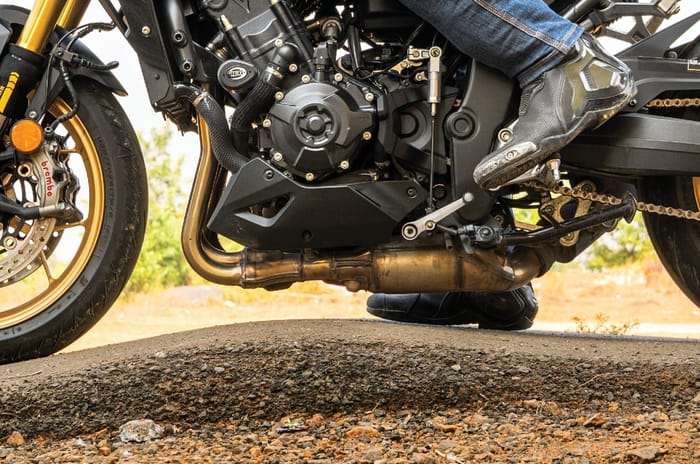
Low ground clearance demands plenty of caution.
While Honda has used steel to construct the frame – unlike other top-tier rivals that use aluminium – show the Hornet a set of twisties, and its 212kg kerb weight seemingly disappears. This supernaked flicks from side to side as if on a knife’s edge! With grippy Bridgestone S22 tyres, fully adjustable Showa fork and fancy Öhlins TTX-36 monoshock, the Hornet SP’s impeccable corner-carving abilities are no surprise.
| Suspension, tyres and brakes | |
|---|---|
| Suspension (F/R) | USD fork / Monoshock (both fully-adjustable) |
| Brakes (F/R) | 310mm dual discs / 240mm disc |
| Tyres (F/R) | 120/70-R17 / 180/55-R17 |
However, what did surprise me was its rather absorptive ride quality in the standard settings over Mumbai’s incessantly bumpy and pockmarked roads. You’ll also find that the Brembo Stylema calipers are more than up to the task of slowing the bike down in a quick and controllable fashion, without overly intrusive ABS intervention. However, the initial bite isn’t ultra sharp like other bikes with similar hardware – likely down to Honda’s more street-friendly choice of brake pads as well as the Nissin brake master cylinder.
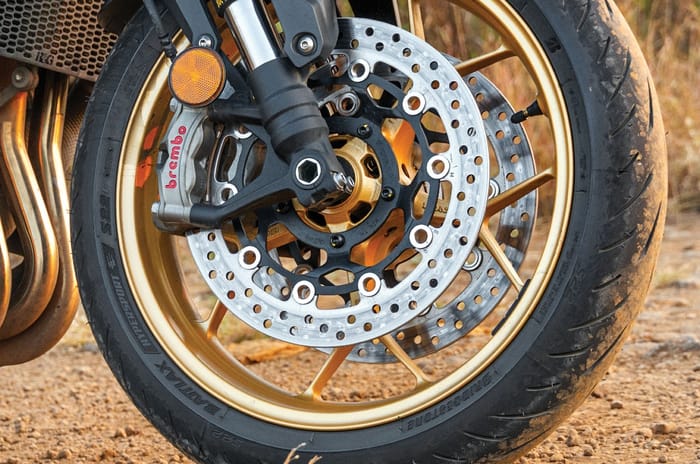
Brakes are powerful without being frightfully so.
While the Hornet is an enjoyable bike in a lot of ways, there are some oddities. First and foremost, why Honda – an otherwise pragmatic organisation – has persisted with the inverted (and hugely confusing!) placement of the indicator and horn buttons remains one of the great mysteries of the cosmos to me!
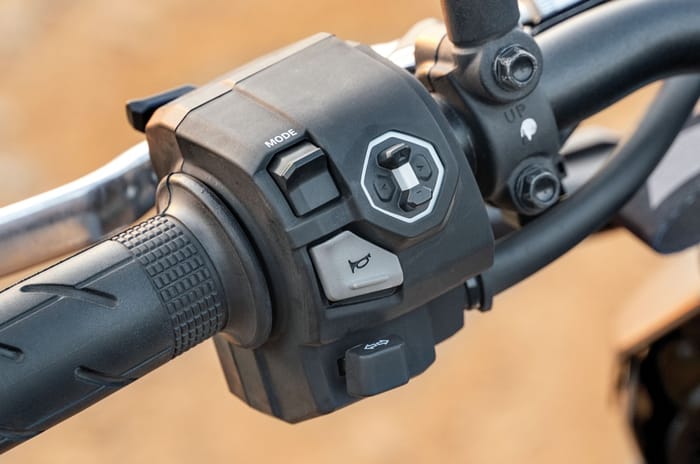
Inverted horn/indicator buttons are annoying.
Riders with larger feet will also find that their right heel makes contact with the exhaust heat shield if you ride with your toes on the footpegs – as you should on a machine like this – although it won’t damage your boots or the muffler itself, so that’s not a big miss. Finally, while the muscular 17-litre fuel tank looks great, it didn’t allow 5ft 11in me and 6ft 1in Rishaad to anchor our thighs to the tank; only the knees made contact. Again, this could be a subjective issue based on your physique, and a set of tank grips will be a somewhat effective and inexpensive workaround.
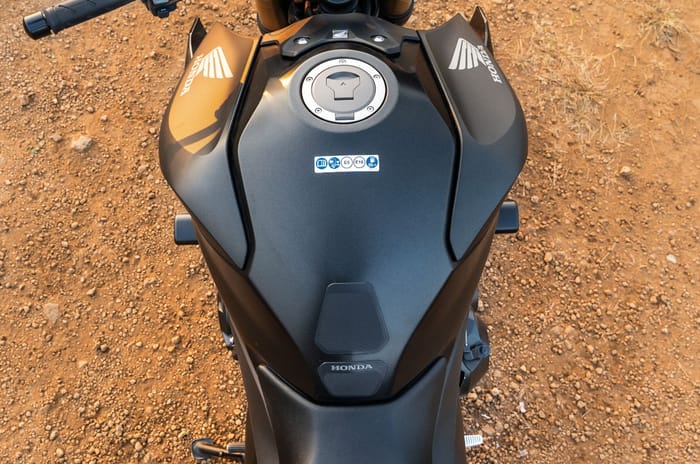
Tank is muscular, but its shape could be more ergonomic.
Honda CB1000 Hornet SP electronics and features – 8/10
It checks all the boxes without going over the top, display’s stratighforward UI a highlight
Helping you use the Hornet’s 157hp/107Nm safely are five riding modes (Sport, Standard and Rain preset) and two fully customisable User modes. You can change these on the move, and they tailor power delivery, engine braking and traction control intervention. Rounding out the suite of electronics is a butter-smooth bi-directional quickshifter and dual-channel ABS. The rider aids aren’t lean-sensitive because the Hornet doesn’t have an IMU (Inertial Measurement Unit), but as long as you’re not chasing tenths and treating the road as your personal racetrack, the rider aids work smoothly in the background.
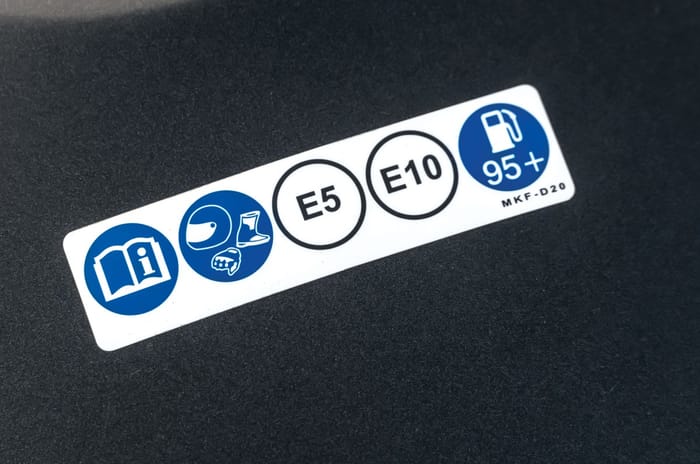
While the sticker on this CBU import denotes EU standards, the Hornet is compatible with Indian E20 fuel, although high-octane petrol is always welcome!
Facing the rider is a clean, uncluttered 5-inch colour TFT display with perhaps the most user-friendly UI I’ve encountered in the big-bike space! Everything is controlled via the straightforward switches on the LH cube, and unlike some other bikes where you need an IT technician to fathom the menus, the Hornet’s settings are easy to change.
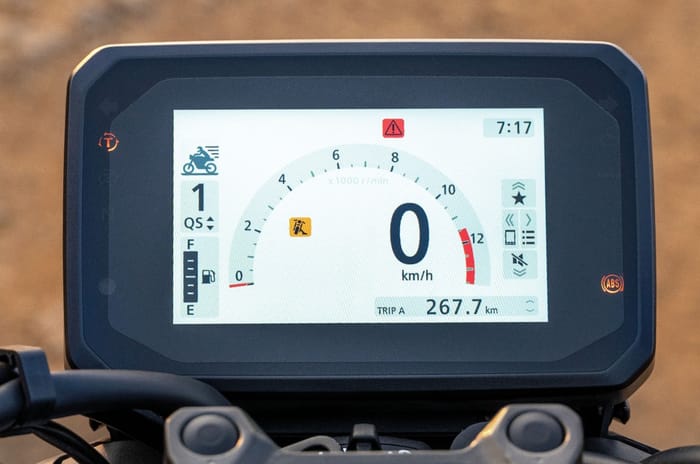
Uncluttered 5-inch TFT has a beautifully straightforward UI.
Since we only get the SP variant of the Hornet in India, you can have it in any colour as long as it’s black with gold wheels. Even so, with its sharp lines and muscular yet svelte silhouette, the well-finished Hornet grabs eyeballs but doesn’t shout for attention like some other swankier big bikes.
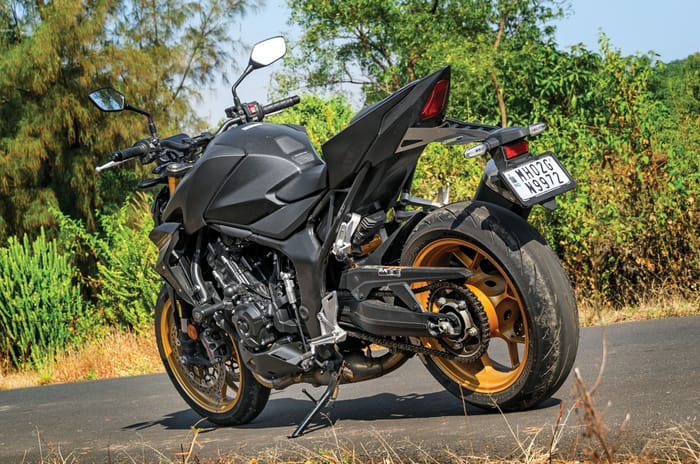
The Hornet 1000 is only available in a single colour in India.
Honda CB1000 Hornet SP price and verdict – 9/10
Even before you consider its stellar price, the Hornet is a fantastic machine
To answer the question we posed at the outset, the CB1000 Hornet SP is an awesome machine with next to no compromise, even before you take into account its very competitive positioning. Despite its explosive performance, you can realistically enjoy it on our roads, which is a tightrope very few big bikes can walk. It’s also important to point out that it’s not dull or overly well-mannered and will definitely put a big smile on your face with every ride.
| Price | |
|---|---|
| Price (ex-showroom, Haryana) | Rs 13.29 lakh |
What only sweetens the deal further is its price. For a similar amount of money, you can get the Triumph Street Triple RS and the Ducati Scrambler Full Throttle – the former is a clear step down, and the latter makes less than half the power!
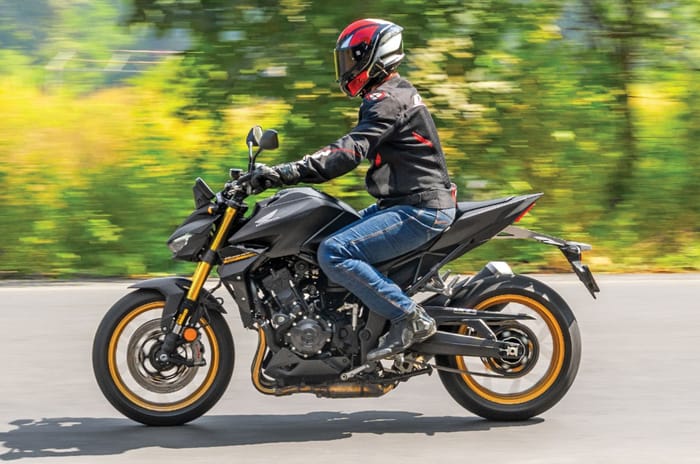
Despite its stellar pricing, the Hornet never leaves you feeling shortchanged in any regard.
Other USPs of the Hornet, on account of it being a Honda, are that it is likely to keep on running faultlessly for years on end and have relatively low running costs. The owner of this bike shared the first service’s bill with us, which amounted to just Rs 6,475, including Rs 2,300 as labour charges – very reasonable for a bike like this. Having owned an Italian supernaked in the recent past, I can vouch for the fact that Honda’s service costs are, in fact, a fraction of most comparable bikes.
All one can hope now is that other manufacturers take note of how impressive the Hornet and its pricing are, and hopefully, this is the start of a wonderful price war that Honda has kicked off!
A big nod of thanks to Khushru Gazdar for loaning us his prized possession so we could bring you this review.
