SPONSORED
There’s a particular kind of devotion you see in Japan – a discipline shaped not by spectacle but by patience and a quest for engineering perfection and craftsmanship.
It’s the kind of dedication that goes into creating the ‘Japan-only’ GLOBAL-IST series of kitchen knives (sharper and more balance), the folding of paper in a tea house, or the shaping of aluminium billet into a shifter knob that feels utterly bespoke.
It’s a culture where mastery isn’t an event – it’s a lifetime. The Honda Civic Type R, in its latest sixth-generation form, belongs to this world.
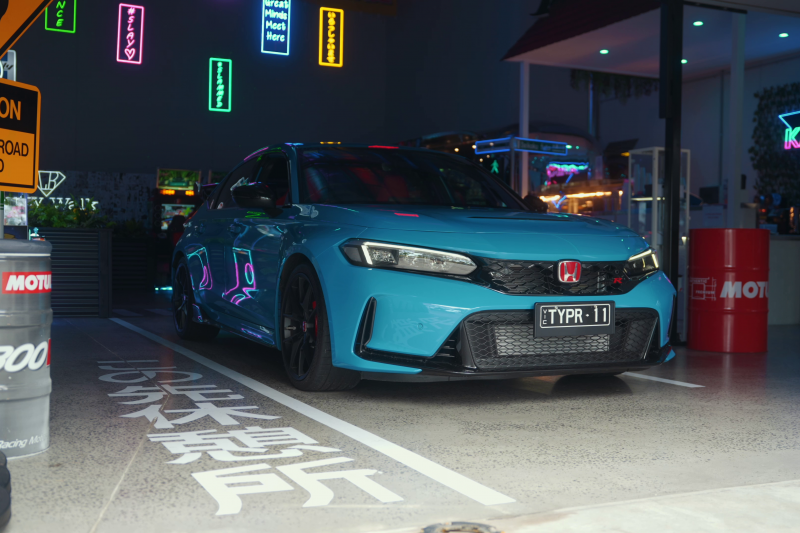
That becomes obvious even before you drive it. On a clear morning in Melbourne, the Racing Blue FL5 Civic Type R sits on display at Kamikaze Garage Cafe – part coffee shop, part shrine to Japanese automotive culture, part love letter to engineering done with pride rather than bravado.
The new Racing Blue paintwork glints under the lights, and the car looks equally at home there, at least as much as the TopSecret R35 that previously occupied the same front-row spot.
Inside, every corner is curated. Quintessential Japanese tuner Liberty Walk lights up the back wall, in neon no less.
Spoon is there, too, and the serviette dispensers on the table booths are NOS canisters. And I can attest the coffee is also a quality brew.
It’s a space built by people who care – the same kind of people who would buy, and truly understand, this car.
Australia understood it early. When the sixth-generation Civic Type R first arrived in 2023, allocation disappeared almost immediately, despite a sticker price nudging $79,000 drive-away.
There wasn’t hype driving that – it was recognition by the cohort best described as ‘If you know, you know.”
The Type R has long been a nameplate for people who don’t simply enjoy driving, but live and breathe it. People who can sense geometry beneath them rather than just read about it.
When Racing Blue arrived in August 2025, the same thing happened again. Gone before most would ever see one.
The Type R is not a mass-market performance car. It is an object of intent.
I first drove this FL5-generation car at its global launch at Estoril Circuit in Portugal, a former Formula 1 venue whose kerbs, camber changes and blind apexes reveal the truth of a chassis, very quickly.
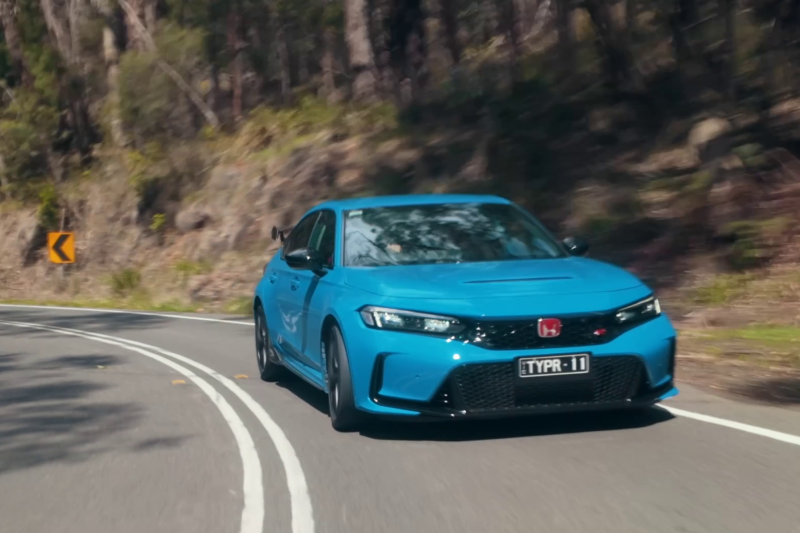
That day, something rare happened: more than one seasoned journalist and a German pro racer driver/instructor walked straight from pit lane to the Honda representatives to place deposits.
The lap-after-lap consistency, the insanely-late braking into turn one, the cooling resilience, the clarity through the steering column, the sense that the car wanted to be pushed harder than you were willing to push it – it was unmistakable. And defining.
Yet track driving tells only part of the story.
A great performance car must also translate its brilliance everywhere from the racetrack, B-road twisties and even the daily commute, to surfaces that ripple and bend, to cambers that weren’t designed for racing, to traffic, to weather, and to the quiet moments between corners.
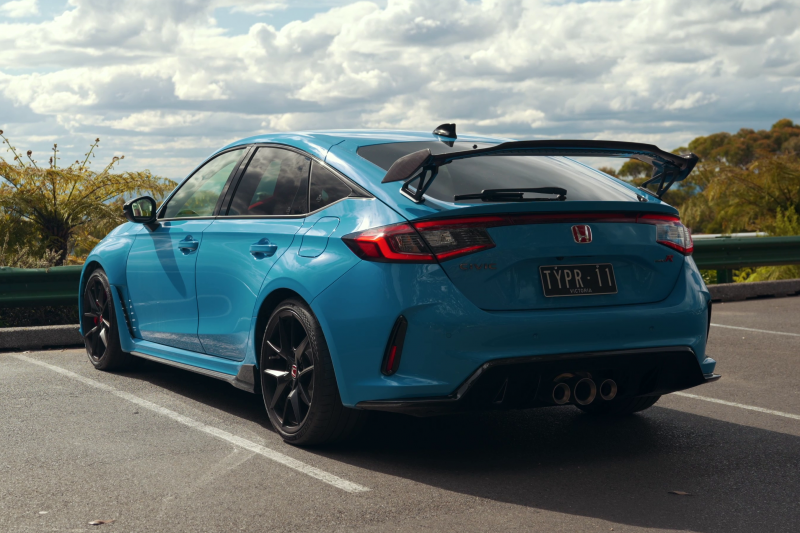
It needs to carry composure into the real world. And so, the Civic Type R and I left the cafe and climbed towards Olinda, threading our way into the Dandenong Ranges east of Melbourne – roads that dip, rise and coil in long, elegant arcs of asphalt between cedar and eucalyptus. Very, very tall ones, too.
The Civic Type R fits these roads as if they were designed for it. There’s a delicacy to the way the car communicates – the steering is precise and unfiltered, but never nervous. The turn-in is razor-sharp but with so much feel.
I’m turning into a super-tight, uphill right-hander a full metre inside the chase car, which just happens to be a very capable 3 Series Coupe, and is clearly on the pace.
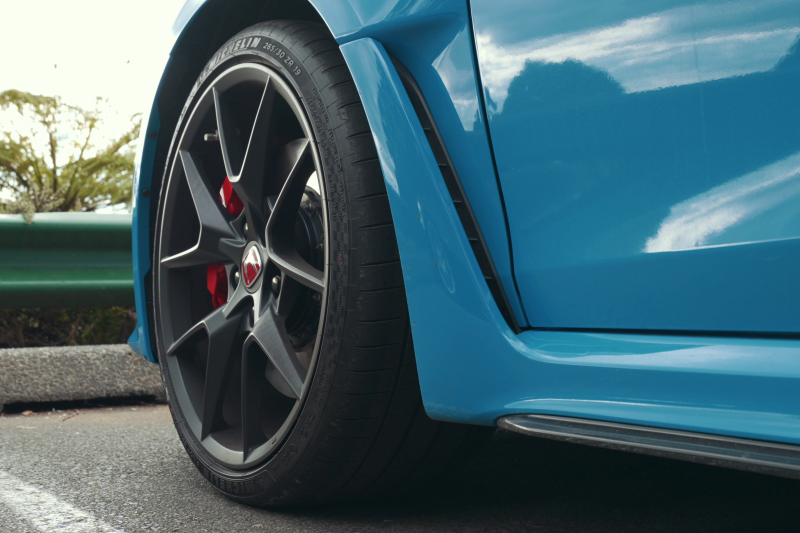
There’s nothing but limitless front-end bite and grip from the Type R’s standard Michelin Pilot Sport 4 S tyres, with no loss of traction – ever – despite Type R’s exclusively front-wheel drive architecture along with countless runs up the same mountain section.
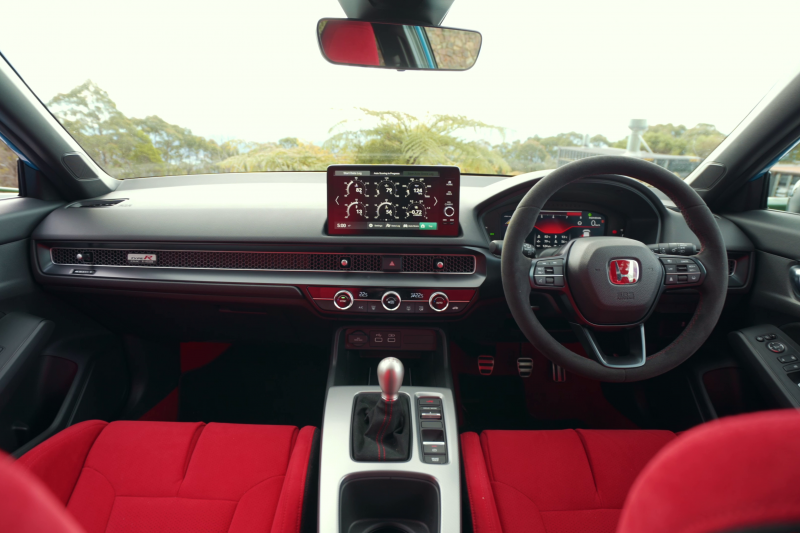
Each one providing the same detailed feedback as the last – to the millimetre, too.
There are precious few sports cars in the sub-$200k segment capable of taking apart tight mountain B-roads such as these with the same preciseness and consistency as the Type R.
And I don’t say that lightly. The Alpine A110 comes to mind, as does the 911 GT3 RS. That’s the kind of comparison I’m talking about here, notwithstanding the difference in outputs.
The suspension breathes with the surface, not against it. There’s tautness, of course, but no harshness. The gearbox remains one of the finest manual shift actions of any car on sale today: short, crisp, mechanical, and deeply satisfying.
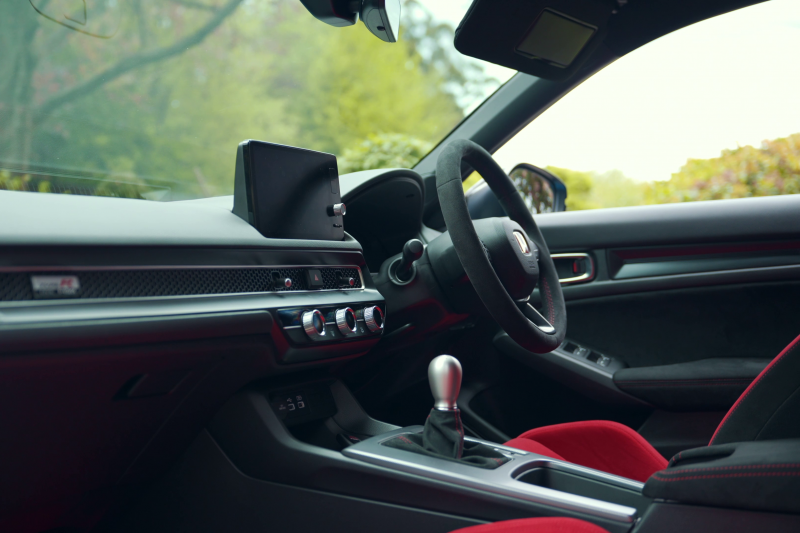
Each change feels predictive but also capable of being hurried using the auto-blip function rather than manual heel-and-toe shifting, especially relevant when you’ve got a well-ridden Ducati Panigale V4 looming up behind.
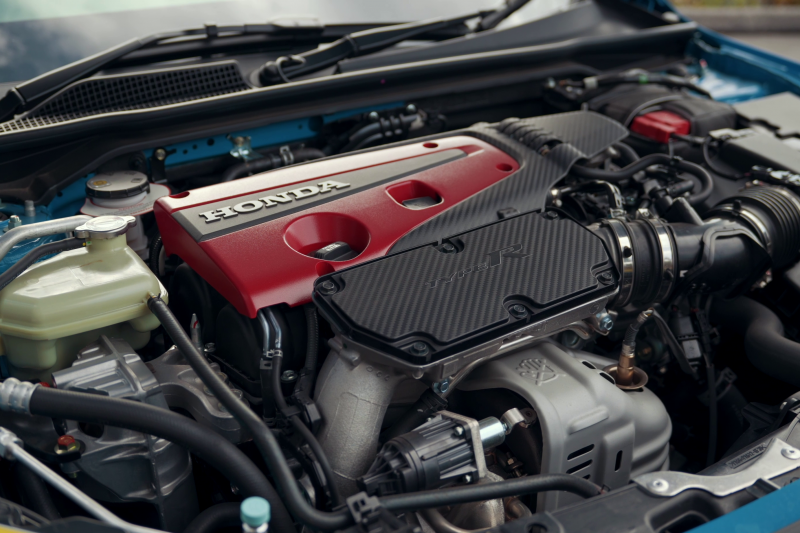
And then there’s the engine. The 2.0-litre turbocharged inline petrol four doesn’t overwhelm the chassis with theatrics. It works with it. Power arrives cleanly, confidently, with no artificial drama or electronically constructed theatre.
For this sixth-generation Type R, the single-scroll turbocharger was further refined with redesigned turbine blades for improved airflow and response.
The car is fast, unquestionably. Mid-range pull is significant, but floor it and it gets properly quick.
But the defining trait is not speed. It’s connection, consistency and feedback. It’s also undeniably comfortable, too – more on that shortly.
This is where Honda’s engineering philosophy reveals itself. The Type R doesn’t rely on short-term stimulation – pops, bangs, exaggerated weighting or digital trickery.
It relies on feel. Everything has been considered, calibrated, and refined by hand and mind.
The decisions are small individually – a lighter tailgate here, a shorter final-drive ratio there, brake cooling redesigned to withstand 10 laps of flat-out running without fade – but together they form a driving experience that feels unified, effortless and entirely intentional.
The road to Olinda narrows as the elevation rises, the air cools, and the scent of pine gets stronger through the window. And eventually, we arrive at Chojo Bonsai Nursery.
It is serene here. Quiet. Bonsai trees arranged like living sculptures, each one the result of years – sometimes decades – of incremental shaping, trimming, wiring, waiting.
Bonsai is an art form defined by restraint. Everything is done slowly, deliberately. The practitioner doesn’t seek perfection in a moment. They chase it across time.
Standing among those trees, the connection to the Civic Type R becomes obvious.
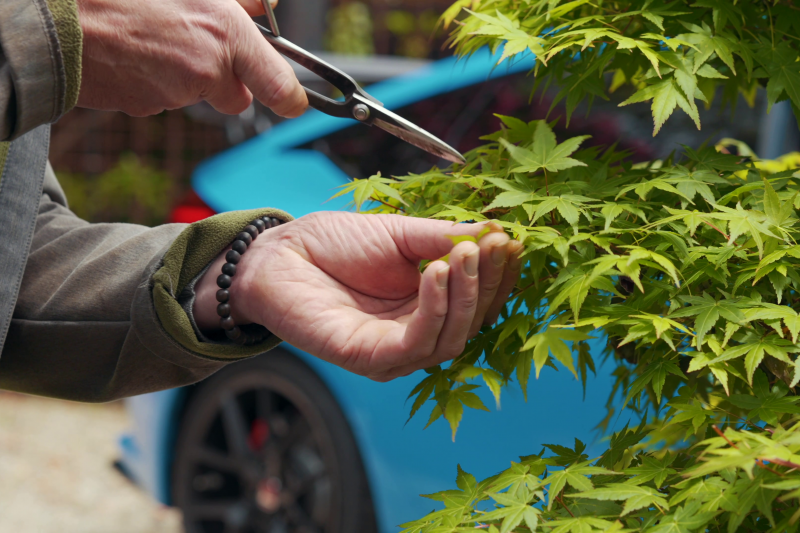
Both are acts of obsessive refinement. Both are shaped by a belief that large transformations come from small, disciplined adjustments repeated over and over.
Both require patience. Both require humility. And both require the understanding that perfection is not a single state – it is a pursuit.
Honda has been in Australia for more than 55 years. Across that time, the company’s reputation has always leaned toward engineering integrity.
But the Type R is something more personal – it is the part of Honda driven by aspiration, the part shaped by the same minds who dream of Formula 1, who see cars not as consumer products but as mechanical expressions of human capability.
As the afternoon settles into gold, the Civic Type R and I leave Chojo and head back into the mountains. The car moves with the same confidence it had on track at Estoril – but here there is something else now.
A softness. A calmness. A sense that, beyond precision, the Type R has something resembling soul. You feel the work behind it – the quiet stubbornness of engineers who refused to let standards slip. You feel the intention.
I’ve said before that this car reminds me most not of other hot hatches, but of Porsche’s GT cars – vehicles engineered not simply for performance numbers but for purity of interaction.
The Civic Type R is not trying to be theatrical. It is not chasing trends. It exists to be driven well, driven often and driven with attention. It is a car for people who appreciate the journey toward mastery.
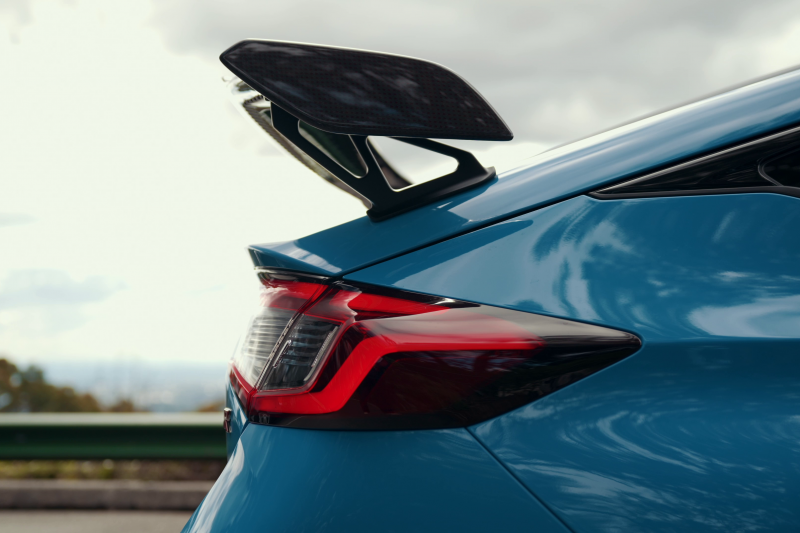
The sixth-generation Honda Civic Type R stands alone now. There are faster cars. There are more expensive cars. There are more powerful cars. But there are none that deliver this particular blend of clarity, control, communication and restraint.
It is a car built not to impress from a distance, but to reward from behind the wheel like nothing else in its class. It stands alone.
But this piece would simply not be complete without high praise of the Type R’s seats. For starters, they’re all-red and upholstered in a combination of premium fabric and Alcantara, but with very aggressive bolsters from seat base to shoulder.
These are proper race buckets, but where Porsche and BMW adopt a far more rigid design that can make ingress and egress a real chore, the Type R’s bucket seats offer superb comfort on and off the track.
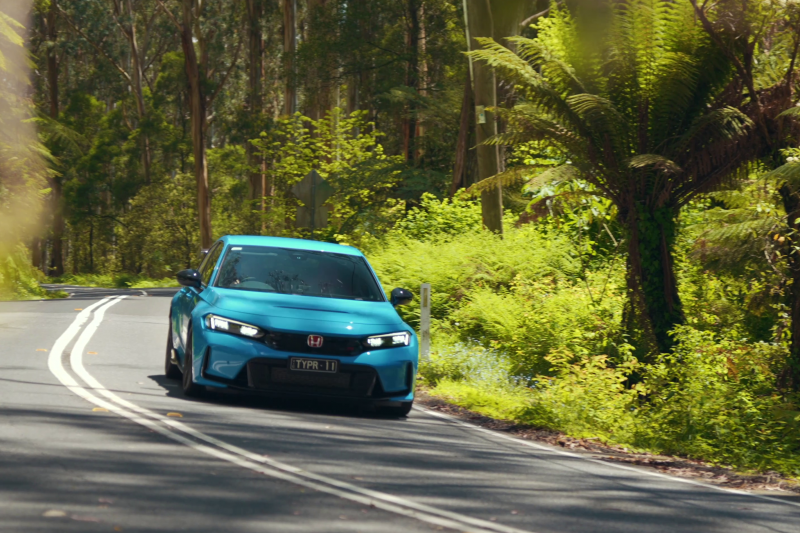
It’s precisely the same story with the Type R’s suspension tuning. The car’s balance is as good as it gets even at speed through the most demanding corners. It tracks straight and doesn’t budge a millimetre off the line no matter what the surface conditions or how hard you push.
But here’s the thing: it’s a lot softer than a Porsche 911 GT car. It’s firm yet compliant, and Honda’s ability to suppress bumps and potholes is simply peerless in my view.
The braking, too, is exceptional. The Type R gets 350mm two-piece floating front discs with four-piston Brembo calipers – and just like on track, there’s incredible resistance to fade while providing brilliant pedal feel at the same time.
This sixth-generation Civic Type R isn’t just engineered for performance – it’s tailored for those after a driving experience that’s completely elevated and, frankly, obsessive in the same way Porsche is with its 911 GT cars.
That’s the best comparison I can make. Every bolt, every surface, every shift… you sense the people behind it. The obsession, the pride, the craftsmanship – that’s what defines Honda.
I said it in my track test, and I’ll say it again: you get a real sense the latest Type R was engineered by aspiring F1 engineers – how else do you explain this level of obsession?
MORE: Explore the Honda Civic showroom
